

What Is a Hammer Mill Used For? A Strategic Processing Asset
In industrial processing, the goal isn't just to "crush material", it’s to achieve a specific, repeatable Particle Size Distribution (PSD) that maximizes downstream efficiency. A hammer mill is an impact-based reduction machine designed to grind, pulverize, and shred materials into uniform particles.
At Prater Industries, we view the hammer mill not as a standalone box, but as the heartbeat of your material flow. Whether you are processing 5,000 HP of scrap steel or micronizing heat-sensitive spices, the physics remains the same: kinetic energy transfer.
The Mechanics of Impact: How Size Reduction HappensUnlike jaw crushers that use compression, hammer mills use high-velocity impact. The efficiency of your mill is dictated by three distinct stages of reduction:
- Primary Impact: The initial strike as material enters the path of the rotating hammers.
- Chamber Collision: Shattered particles are accelerated against breaker plates and other incoming material.
- Shear & Attrition: The final sizing occurs as material is ground between the hammer tips and the discharge screen.
2. Industrial Applications: Where Hammer Mills Drive ROI
The versatility of the hammer mill allows it to serve as a primary, secondary, or tertiary grinder across dozens of industries. If you manage a processing operation, you likely face a common problem: raw material comes in at one size, but your downstream process demands another. Hammer mills bridge that gap.
Common Industry Use Cases:
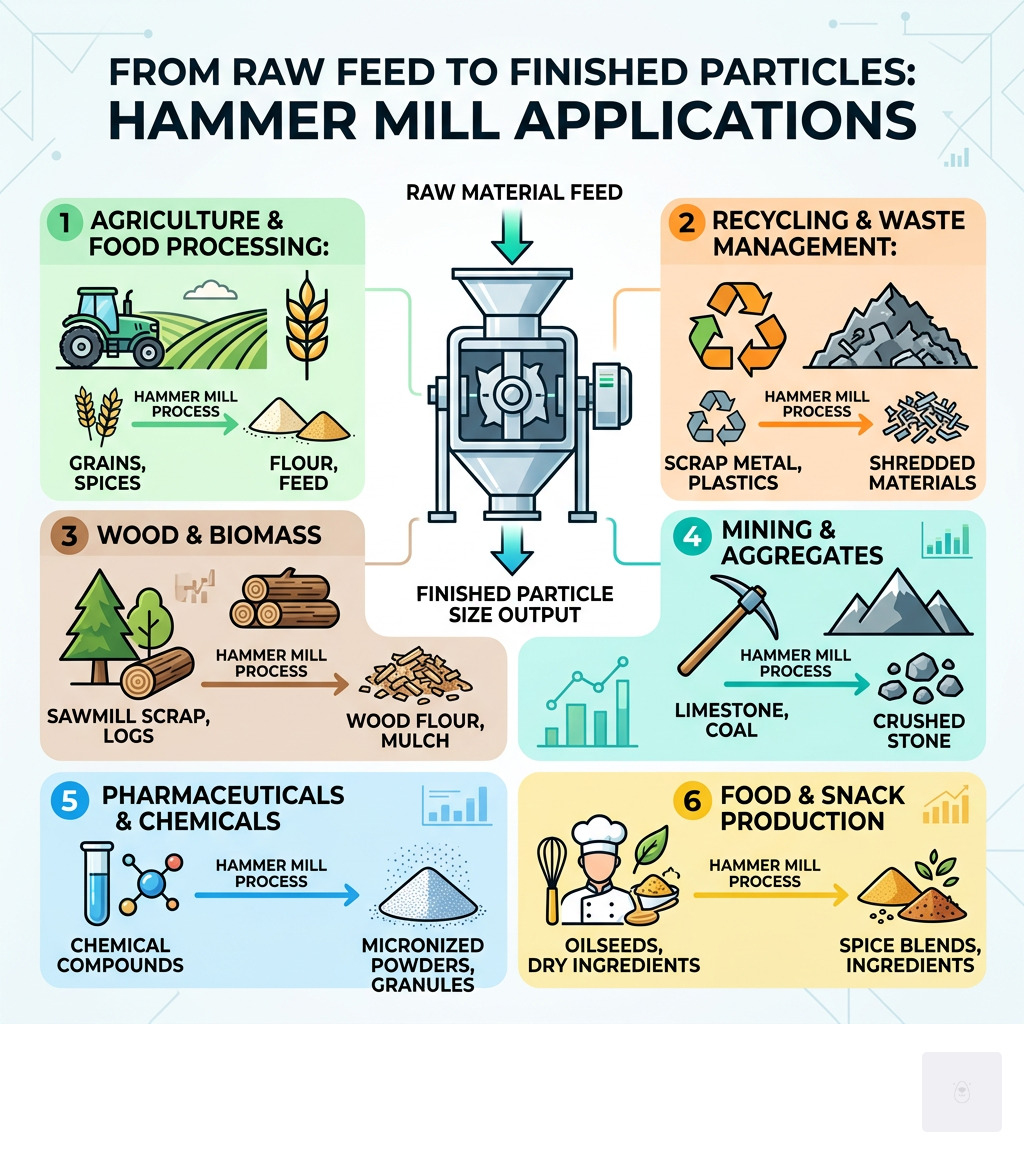
- Agriculture and Food Processing: Grinding grains, milling flour, processing spices, and producing animal feed.
- Recycling and Waste Management: Shredding scrap automobiles, grinding used pallets into mulch, and processing e-waste.
- Wood and Biomass: Reducing sawmill scrap, producing wood flour, and preparing boiler fuel.
- Mining and Aggregates: Crushing limestone, concrete, coal, and other low-abrasive materials.
- Pharmaceuticals and Chemicals: Micronizing powders, improving solubility, and producing uniform granules.
- Food and Snack Production: Pulverizing spices, processing oilseeds, and grinding heat-sensitive ingredients.
Proof in Production: See how we optimized throughput for soy flakes and managed moisture in our Case Study: Pet Food and Soy Flake Grinding. For high-wear recycling applications, learn how we manage abrasives in our Case Study: Abrasive Charcoal Applications.
3. Configuration Strategy: Gravity vs. Pneumatic
One of the most frequent mistakes in plant design is choosing the wrong discharge method. Your material density determines your system architecture.
| Feature | Gravity Discharge | Pneumatic Suction |
|---|---|---|
| Material Density | High (Heavy/Friable) | Low (Light/Dusty) |
| Best For | Coal, Glass, Minerals | Wood Shavings, Biomass, Spices |
| Throughput | Standard | 3-4x Increase for light solids |
| Cooling | Passive | Active (Assists in heat dissipation) |
Optimizing the Screen-to-Horsepower Ratio
Beyond the discharge method, the most critical factor for Optimum Hammer Mill Performance is the relationship between screen area and tip speed.
Engineers should prioritize maximizing the screen-to-horsepower ratio. As detailed in our Full Screen Hammer Mill Data Sheets, a larger screen area ensures that once a particle is "on size," it exits the chamber immediately. This prevents the "recirculation effect" or over-grinding, which is the primary cause of wasted energy and the creation of unwanted fines. By allowing material to exit as soon as it reaches the target micron, you maintain lower internal temperatures and significantly increase total throughput.
Technical Deep-Dive: For specific clearance tolerances and motor configurations, View Prater’s Full Product Literature & Technical Data Sheets to access PDF manuals for our Full Screen and Mega Mill series.
4. Operational Reliability: Maintenance and Wear Parts
In a high-capacity production environment, the hammer mill is often the most heavily worked machine on the floor. Because it relies on high-velocity impact, wear is a functional reality. Success is measured by how effectively you manage that wear to prevent "Unscheduled Downtime."
Critical Spare Parts List
Maintaining a "safety stock" of these components ensures your equipment operates at its designed mechanical integrity.
| Part Category | Specific Component | Function & Impact | Replacement Indicator |
|---|---|---|---|
| Wear Components | Hammers / Blades | Primary impact surface. | Rounded edges or 20% mass loss. |
| Sizing Media | Screens / Grates | The PSD "gatekeeper." | Visible holes, thinning, or blinding. |
| Rotor Assembly | Bearings & Seals | Ensures smooth rotation. | Increased vibration or heat. |
| Power Train | V-Belts & Bushings | Transfers motor torque. | Fraying, glazing, or loss of tension. |
| Safety & Sealing | Door Gaskets | Prevents dust egress. | Brittleness, tearing, or leaks. |
| Fasteners | Hammer Pins / Rods | Secures hammers to rotor. | Grooving (notching) or bending. |
Sourcing Genuine Parts and Technical Support
Using "will-fit" parts from third-party vendors often leads to fitment issues and unbalanced rotors. Genuine Prater Parts are engineered to the exact metallurgy and weight specifications required for your specific model to maintain dynamic balance at 3,600 RPM.
Maintenance Resources: To help your team develop a proactive service schedule, you can Access Prater Equipment Manuals and Maintenance Guidelines. For detailed lubrication intervals and tool-less inspection procedures, refer to our technical manual library.
Conclusion: Balancing Mechanical Force with Process Precision
As we’ve explored, the hammer mill is far more than a simple "crushing box", it is a precision tool for energy transfer. Whether you are managing the abrasive wear of mineral processing or the delicate thermal requirements of food production, success depends on the alignment of rotor tip speed, screen geometry, and discharge method.
Optimizing a milling circuit isn't a one-time event, but a continuous effort to reduce the "efficiency gap" where energy is lost to heat and vibration. When these variables are controlled, the result is a narrower particle size distribution, reduced utility costs, and a significantly longer equipment lifecycle.
From Technical Theory to Field Application
Understanding the physics of impact is the first step toward a more reliable floor. The second is validating those theories against your specific material. Because no two materials fracture identically, the most reliable path to a 75-micron (or sub-44 micron) target is through data-driven testing and site-specific audits.
Rather than guessing at configurations, we encourage you to leverage the century of material data we’ve compiled. Our role is to provide the technical bridge between your raw material challenges and your finished product requirements.
Are you ready to validate your process? The most effective way to finalize your system design is through a material trial or a technical facility audit. You can connect with a specialized Technical Specialist in your region to review your current process flow diagram (PFD) or schedule a test in our Bolingbrook laboratory.
Frequently Asked Questions: Industrial Hammer Mill Operations
What is a hammer mill used for in pharmaceutical production?
In the pharmaceutical industry, hammer mills are used for micronization and granulation. By reducing active pharmaceutical ingredients (APIs) and excipients to a precise, uniform particle size, manufacturers can improve drug bioavailability and ensure consistent tablet weight and dosage. They are also used to pulverize materials for high-speed tablet presses where flowability is critical.
How does rotor speed (tip speed) affect finished particle size?
Rotor speed, specifically "tip speed," is the primary lever for adjusting fineness. A higher tip speed increases the frequency and energy of each impact strike, shattering material into smaller particles. Conversely, slowing the rotor reduces the force of impact, resulting in a coarser product with fewer unwanted "fines."
How does moisture content affect hammer mill efficiency?
Ideally, material for dry milling should be below 5% moisture. As moisture levels rise, the material becomes "hygroscopic" or sticky, which leads to clumping. This causes screen blinding, where particles plug the discharge openings, spiking internal temperatures and potentially leading to motor failure. For materials with higher moisture (up to 15%), pneumatic assistance or specialized air-swept designs are required.
What is the difference between Mesh size and Micron size?
Mesh refers to the number of openings in one linear inch of a screen (e.g., a 200-mesh screen has 200 openings per inch). Micron (µm) is a metric measurement of the actual particle size (1 micron = 1/1,000,000 of a meter). As the Mesh number increases, the openings become smaller, and the Micron size decreases. For example, a 325-mesh screen corresponds to approximately 44 microns.
When should I replace my hammers or blades?
You should flip or replace hammers once they have lost roughly 20% of their mass or the leading edge becomes significantly rounded. A rounded hammer loses its ability to "fracture" material, instead "pushing" it around the chamber. This creates excessive friction and heat, drastically increasing your energy cost per ton of material processed.
Why is a "Full Screen" design better for certain applications?
A Full Screen Hammer Mill maximizes the available screen area relative to the horsepower of the motor. This allows particles that have already reached the target size to exit the grinding chamber immediately. This prevents "over-grinding," which saves energy and prevents heat-sensitive materials (like spices or resins) from melting or degrading.
How often should I lubricate hammer mill bearings?
Lubrication intervals depend on the RPM and operating temperature of the mill. Because hammer mills operate at high speeds, over-greasing can be as damaging as under-greasing by causing internal friction. Always refer to your Prater Equipment Manual for the specific grease type and "shot" frequency tailored to your model’s bearing housing.